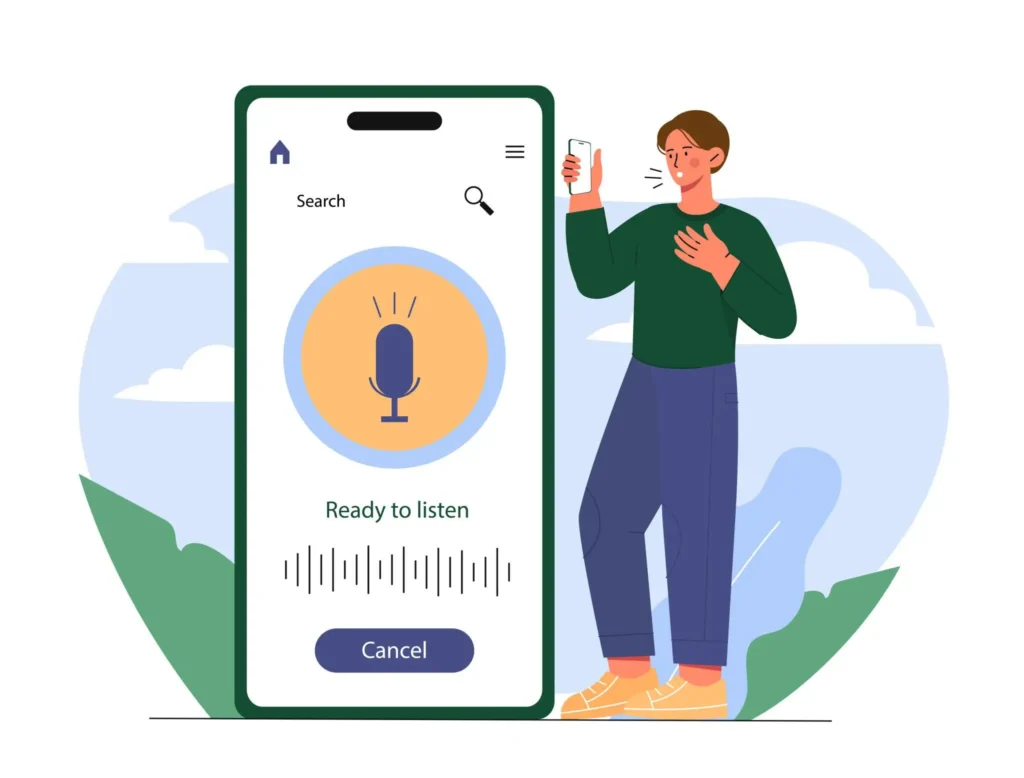
The era of voice search has now come of age, and people increasingly use this modality to interact with the online world. They tell their smartphones what they want as they stroll, command their smart speakers when they cook, and turn to voice-based assistants to quickly solve everyday issues.
For marketers and content producers, this new user behavior creates a significant paradigm shift in the basic approach to optimizing websites for search engines. The keyword-centric SEO techniques used in the past will no longer work because voice-based search is inherently long-tailed and contextual.
Your website needs to evolve to accommodate the ways in which people really speak. Failing to do so may result in missing out on a lot of high-potential searches to websites optimized to match people’s real language skills.
The Behavioral Shift: Spoken vs. Typed Search
Voice search optimization can be defined based on analyzing the differences between a voice search and a regular text-based search. Typing out queries from their seats, users are brief and disjointed when asking questions—”best “mechanic Austin” or “oil change price.”

However, if the individual uses a voice command feature to ask for information, they will phrase it more fully as “Where is the nearest mechanic open at the moment?” and “What is the total cost of a full synthetic oil change service?”
In linguistic terms, voice search is marked by complete sentences and transactional queries made with the use of question words such as who, what, where, when, why, and how. Since the users multitasking while conducting a search with voice command are looking for clear-cut answers immediately, they don’t have time to do a research paper.
In addition, the regular search produces a list of options on one page, with the choice being made by the user themselves. On the other hand, voice assistants provide users with only one specific result. Thus, there is no ranking page anymore; instead, there is a race for one position in the featured snippets list.
Transitioning Content From Keywords to Conversational Phrasing
Voice search optimization implies switching from targeting certain keywords to creating articles around full conversational expressions. Although most traditional keyword research tools are aimed at identifying popular keyword phrases, voice search algorithms prefer long-tail phrases mimicking normal conversations.

Thus, in order to find proper conversational phrases, try to listen carefully to the questions asked by clients during their real interaction with representatives of your company. Study the text in letters to customer support, review client applications for the services you offer, and analyze customer complaints left on social media sites. Informational parts of search engines such as autocomplete and direct question fields can provide important hints on the conversational phrases spoken in real life.
After discovering these sentences, you should use them in your texts in a way that will make the text flow naturally when pronounced. You can either place these phrases as headings or start paragraphs with those. The rule of thumb here is to make sure that the sentence does not sound awkward and artificial when pronounced.
Implementing an Answer-First Content Structure
Because voice assistants aim to provide immediate answers without forcing the user to read or listen to unnecessary background information, the layout of your content is critical. Winding introductory paragraphs that take several hundreds of words to get to the point do not perform well in voice search environments.
A practical framework for writing for voice is the answer-first method. When structuring a page or a specific sub-section, state the direct, clear answer to the target question in the very first sentence. Keep this summary concise, ideally between 30 and 50 words, using plain language. Once you have delivered the immediate answer, use the remaining paragraphs to provide deeper context, technical specifications, background data, or nuance.
This structure creates a clear path for search engine crawlers. When an automated bot indexes your page, it can immediately identify the concise summary as a perfect candidate for a voice response, using the subsequent text to confirm the authority and accuracy of that summary.
The Strategic Value of FAQ Layouts
Frequently Asked Questions sections are highly effective for voice search optimization because their native structure perfectly matches the user journey of a voice query. An FAQ format is built entirely on a direct question followed immediately by a clear, standalone answer.
When building these sections on your website, focus on clear formatting:
- Dedicated Headings: Give each individual question its own clear heading rather than grouping unrelated topics together.
- Concise Summaries: Keep the initial answer direct, clear, and easy to understand on the first listen.
- Actionable Content: Focus on solving a single, distinct problem per question.
Writing these sections in plain language ensures that voice delivery engines can parse your data with minimal effort. This conversational clarity helps both the automated algorithms index your site accurately and human readers find information quickly.
Technical Foundations: Structured Data and Security Protocols
While writing naturally is essential, the technical framework under your website code provides the structural signals that search engines rely on to trust your content. Algorithms must sift through massive amounts of information instantly to answer a verbal command, and technical optimization helps guide those crawlers directly to your answers.
Implementing structured data code, known as schema markup, gives search engines explicit context about what your text means. By using specific markers like FAQ schema, Product schema, or LocalBusiness schema, you tell the search engine exactly where a question begins and where the verified answer ends. This reduces ambiguity and allows search engines to pull your text with high confidence.
In addition to code formatting, website security serves as an essential trust signal. Secure websites utilizing HTTPS encryption protocols are systematically preferred over unsecured HTTP alternatives. Because voice assistants act as a single recommendation source, their parent systems avoid reading out answers from websites that lack valid security certificates or modern data encryption standards.
Optimizing for Regional and Local Intent
A significant portion of daily voice commands are tied to immediate local needs. These queries are often made on mobile devices by users who are driving, walking, or looking for immediate services in their immediate vicinity. They speak commands like “find an open hardware store near me” or “who fixes burst pipes in this area.”
To capture this local traffic, your business listings must be accurate and uniform. Ensure that your core directory listings, mapping profiles, and contact pages feature identical business details. Any discrepancies in your business name, street address, or local phone number can lower the trust search engines place in your business data, causing them to choose a competitor with more consistent records.
Beyond directory alignment, weave specific local details naturally into your website text. Mention neighborhood names, local landmarks, well-known intersections, and regional service boundaries within your service pages. This aligns your content with how local residents naturally describe their location when speaking to a device.
Prioritizing Mobile Performance and Speed
Voice search is deeply tied to the mobile browsing experience. Because users expect an immediate audio answer to their verbal prompt, page loading speed and mobile performance are critical pillars of a voice search strategy. A website that takes several seconds to display on a smartphone will rarely be chosen as a voice answer source.
To optimize your technical performance, focus on improving your mobile user experience and core vitals. Streamline your site code, eliminate heavy or redundant scripts, utilize browser caching, and use responsive designs that format cleanly on screens of all sizes.
Search engines evaluate the mobile versions of websites first when determining overall authority. If your mobile layout is slow or difficult to navigate, your overall visibility will suffer across all search platforms, including voice.
Common Layout Pitfalls to Avoid
Burying the Primary Answer Deep within Paragraphs: Many optimization efforts fall short when the core takeaway is hidden under introductory fluff. If a search engine algorithm has to parse through several sentences of filler text just to find a simple detail or definition, it will quickly move on to a competing site that presents the conclusion first.
Using Overly Complex, Jargon-Heavy Vocabulary: Voice assistants are specifically built to deliver clear, accessible information that is easy for a human to understand audibly on the first listen. You should avoid long, winding sentences filled with multiple clauses and instead focus on writing clear, active sentences that explain concepts simply.
Failing to Update Website Data After Business Changes: Neglecting to refresh your digital footprint can quietly destroy your rankings. If you adjust your hours, move physical locations, or change phone numbers without immediately updating your website text, structured schema, and local business listings, search engine algorithms will encounter conflicting information. When faced with mixed or conflicting data, search engines will completely withhold your site from voice answers to avoid misinforming the user.
Long-Term Consistency and Visibility
Optimizing a website’s voice is a continuous process of refining clarity, structure, and speed in line with the nuances of human communication. Those sites that will flourish in this space are the ones that embrace utility, simplicity, and clear page structures.
The starting point to building a successful voice marketing strategy lies in identifying the genuine questions your clients pose every day. This should be followed up by structuring your landing pages to answer those queries immediately, utilizing clear formatting, accurate schema markup, and ensuring that your mobile site speeds continue to perform well. By creating content that is easily comprehensible to human speech and search bots alike, your site will remain relevant.