The local search ecosystem has fractured. For over fifteen years, local search engine optimization (SEO) was a predictable game: optimize your Google Business Profile, acquire location-specific citations, build proximity relevance, and watch your business climb into the coveted local map pack.
The integration of real-time search capabilities into Large Language Models (LLMs), pioneered by engines like ChatGPT Search and Perplexity AI, has fundamentally shifted user behavior. Generative answer engines now expose local businesses through selective contextual citation rather than a simple ranked list of blue links.
If a local service provider or brick-and-mortar storefront is not visible inside these AI responses, they do not exist for a rapidly growing segment of high-intent consumers. This comprehensive analysis evaluates the architectural differences between ChatGPT Search and Perplexity AI for local business discovery and details the execution framework required to dominate this new era of Generative Engine Optimization (GEO).
The Core Dilemma: Two Distinct AI Search Philosophies
To optimize local visibility effectively, one must understand that ChatGPT Search and Perplexity approach web extraction and user intent from entirely different architectural philosophies.
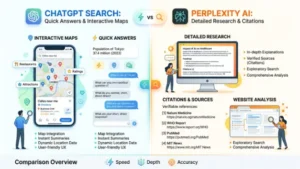
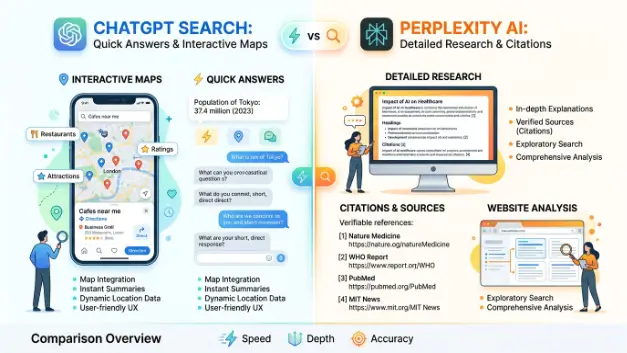
- ChatGPT Search Strategy: Focuses on rapid intent matching and reducing user friction. When a local query enters its system, it bypasses heavy textual research in favor of instant utility. It uses its web index and strategic mapping partnerships to generate an interactive map card directly in the user interface, routing the user to fast, conversational endpoints like direct click-to-call or immediate location tracking.
- Perplexity AI Strategy: Functions as an investigative multi-source synthesis engine. Instead of a quick directory match, it runs live, feature-level scraping across individual business websites, reviews, and local content structures. It presents its findings through dense textual analysis supported by exhaustive sidebar links, giving the user a deep research profile for highly specific or long-tail local needs.
ChatGPT Search: The Instant Answer Machine
When OpenAI integrated a dedicated search product into ChatGPT, it prioritized speed, conversational flow, and clean user experience. For local queries, such as “find an emergency plumber near me” or “best artisanal coffee shop downtown,” ChatGPT acts as an action-oriented discovery layer.
It synthesizes real-time web data with geographical mapping interfaces. It heavily favors dominant aggregator platforms, third-party directories, and licensed publisher content to build highly scannable, visual recommendation blocks complete with inline maps and direct interaction points.
Perplexity AI: The Deep Investigative Assistant
Perplexity operates as a multi-source synthesis engine. Instead of simply matching user intent with a directory card, Perplexity treats every local query like a mini research project. It aggressively scrapes the live web, cross-references individual business websites, evaluates localized content structures, and aggregates user reviews from across multiple platforms.
If a user inputs a highly specific query like “Which commercial movers in San Jose handle laboratory equipment and have verified weekend availability?” Perplexity dissects the structural and linguistic properties of regional web pages to uncover the correct answer.
How ChatGPT Processes Local Queries
ChatGPT’s local search architecture relies significantly on established web authorities and strategic data partnerships. Because it aims to minimize user friction, it tends to deliver definitive, highly curated recommendations.
The Power of Directory Authority
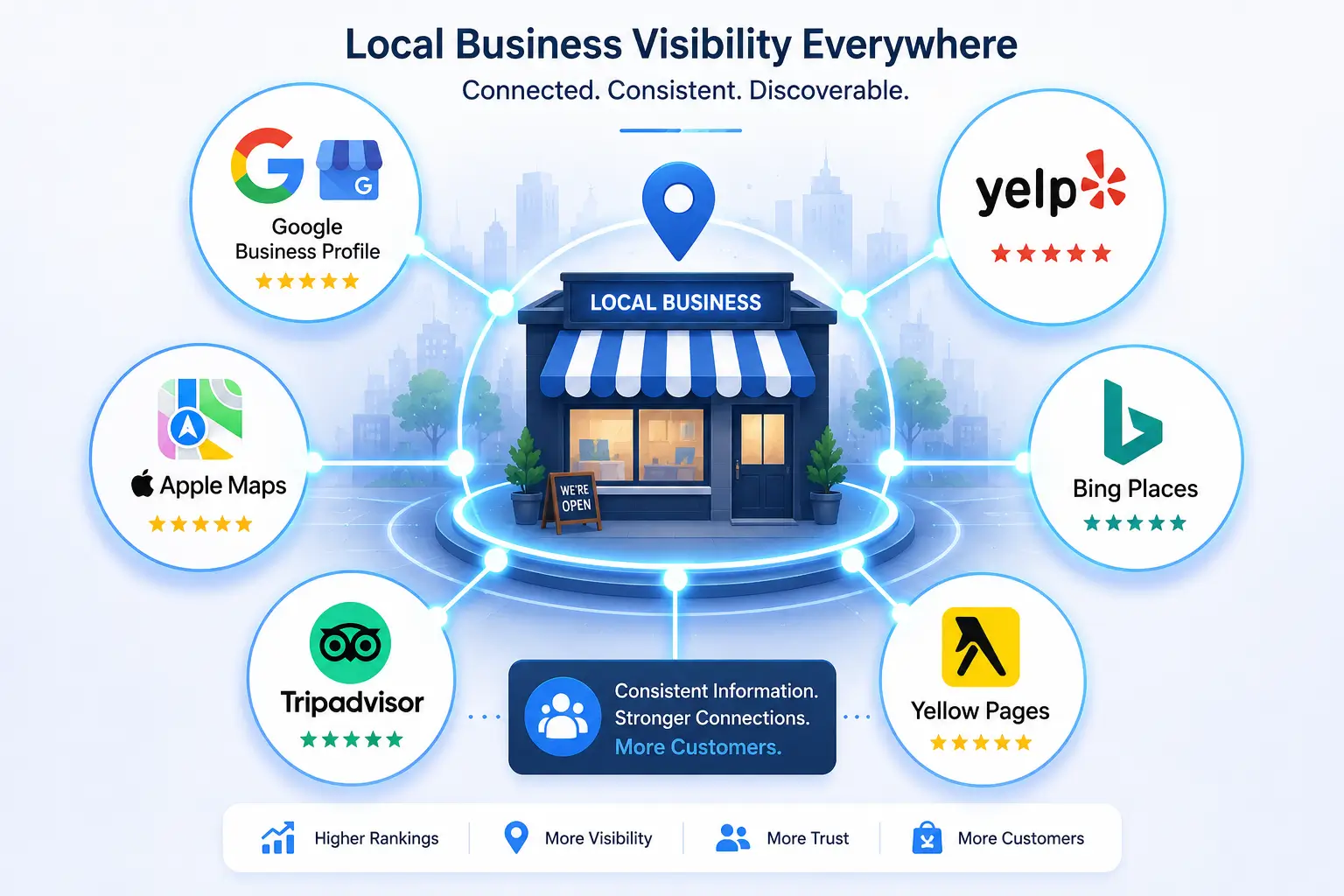
ChatGPT doesn’t build its local understanding entirely from scratch. It cross-references top-tier platforms like Yelp, TripAdvisor, YellowPages, Apple Maps, and specialized industry directories. If a local business has inconsistent Name, Address, and Phone Number (NAP) details across these networks, ChatGPT’s retrieval-augmented generation (RAG) pipeline may filter the business out due to conflicting data trust signals.
Brand Mention Density & Citations
OpenAI’s local interface highlights inline attributions and side panels containing source links. ChatGPT measures digital PR equity. Local businesses that routinely earn mentions in regional news outlets, local lifestyle blogs, and neighborhood roundups develop strong text-based semantic connections. When a user asks for top recommendations, ChatGPT draws on these authoritative textual links to justify its choices.
How Perplexity Evaluates Local Businesses
Perplexity approaches the web with an unbundled perspective, making it highly sensitive to on-page semantic writing, customer sentiment analysis, and feature-level website optimization.
Deep On-Page Semantic Context
Perplexity excels at answering complex, long-tail local queries. Traditional keyword-stuffed service pages fail in this environment. Perplexity scans websites for deep semantic clarity. It looks for natural explanations of specialized services, transparent pricing models, clear service region definitions, and contextual proof of expertise.
Granular Review Aggregation and Sentiment Parsing
While ChatGPT looks for generalized ratings, Perplexity regularly parses the actual textual content within customer reviews. It extracts specific entities and sentiments from what customers say. If multiple client reviews praise a local moving company for “impeccable wrapping of antique furniture,” Perplexity catalogs that specific capability. When an AI user prompts for that exact service trait, Perplexity surfaces that business based on the extracted review context.
Head-to-Head Comparison: Local Search Execution
The following deep dive compares how both platforms handle real-world local user journeys.
Scenario A: High-Intent, Immediate Local Service Discovery
- Query: “AC repair open right now near me.”
- ChatGPT Behavior: Instantly pulls geographic coordinates, cross-references live business hours via mapping APIs, and outputs an interactive map component with 3–4 verified open options, emphasizing direct click-to-call functionality.
- Perplexity Behavior: Generates a list of open providers, synthesizes real-time status updates from active websites, and adds a detailed textual summary explaining why these options are reliable, drawing from recent web updates and reviews.
Scenario B: Research-Driven, Quality-Focused Local Service Selection
- Query: “Best corporate relocation services for tech companies in Austin”
- ChatGPT Behavior: Relies heavily on authoritative B2B directories, business journals, and top blog roundups to list established agencies with clean, high-level summaries.
- Perplexity Behavior: Scrapes the corporate service pages of individual regional companies, looks for case studies or explicit text detailing tech-sector experience, and outputs a highly detailed matrix comparing their specialization, client histories, and core service offerings.
Step-by-Step Blueprint for LLM Search Optimization
To ensure a local business ranks consistently across both ChatGPT and Perplexity, local digital strategies must shift toward an unsiloed, entities-first framework. The following sequence details how to build and maintain comprehensive AI visibility.
- Establish an Immutable Entity Baseline:
Clean up every core digital map and primary directory asset. Ensure that your corporate legal name, primary operating address, direct local phone line, and operational hours are identical across Apple Maps, Bing Places, Yelp, and your Google Business Profile. AI retrieval pipelines cross-reference these nodes to establish operational truth.
- Deploy Advanced Schema Architecture:
Inject a highly detailed JSON-LD LocalBusiness schema into your website’s core architecture. Go beyond basic contact info; explicitly define fields like geocoordinates, price range, and area served (listing specific zip codes and neighborhood entities) and know about declaring exact vocational specializations directly to AI crawlers.
- Re-engineer content for semantic completeness:
Strip out robotic, repetitive geo-targeted phrases (e.g., “best mover in town, top mover in town”). Replace them with deeply informative, human-written content that answers specific user pain points. Detail exactly how your local service operates, outline your equipment, explain compliance metrics, and provide explicit, contextual case studies or project summaries.
- Cultivate Descriptive Unstructured Citations:
Execute a localized digital PR strategy designed to generate contextual text mentions. Secure coverage in regional business spotlights, sponsor neighborhood events that link to your brand name, and encourage customers to write highly descriptive reviews that name specific services, team members, and neighborhoods rather than leaving generic five-star ratings.
The Strategic Shift: Moving From Keywords to LLM Context Windows
In traditional search engines, optimization focused on convincing an algorithm to rank a specific URL for an isolated keyword string. In the era of conversational, generative search, optimization requires embedding your local brand into the context window of the AI’s response model.
The Core Rule of GEO: Generative models do not look for the most optimized webpage; they look for the most contextually complete, authoritative answer to a human user’s highly specific question.
The Role of Natural Language Patterns
AI engines are highly sophisticated at identifying artificial patterns. Websites filled with unnatural, repetitive local landing pages are increasingly filtered out during the early retrieval stages of AI-powered engines. Content must be structured to match natural human discussion. Write comprehensive service breakdowns using natural phrasing, transparent explanations, and authentic domain expertise.
Capitalizing on Multi-Objective Optimization
Maximizing visibility in AI search requires a balanced approach to structural, content, and linguistic properties. This means a business website must feature fast, clear technical organization alongside rich, authoritative information. Local service pages should include structured tables detailing specific service features, clear answers to regional FAQs, and verified customer testimonials embedded directly into the page layout.
Building a Future-Proof Local Footprint
The ultimate choice in the battle between ChatGPT Search and Perplexity AI for local business discovery isn’t about picking a winner, as it’s about understanding that they represent the two core ways modern consumers seek information.
- Optimize for ChatGPT to capture immediate, transactional local intent where quick navigation, direct communication, and directory trust dictate who gets the customer.
- Optimize for Perplexity to capture analytical, research-driven local consumers who use complex prompts to find businesses that handle highly specific, long-tail requirements.
By building clear entity records, writing deep semantic content, and maintaining consistent information across directories, local brands can position themselves to rank well on both platforms. The future of local search belongs to businesses that move past basic keyword tracking and embrace deep digital visibility.