Google’s AI Mode introduces an advanced approach to discovering information beyond the classic list of ten blue links, which means the rank tracking methods that have served SEO teams for two decades are evolving into entirely new frameworks. This guide explains exactly how AI Mode generates its answers, how tracking methodologies are adapting to these changes, and the precise tracking framework that gives your team an accurate, actionable view of where your brand stands.
Traditional Search Ranking vs. AI Mode Visibility
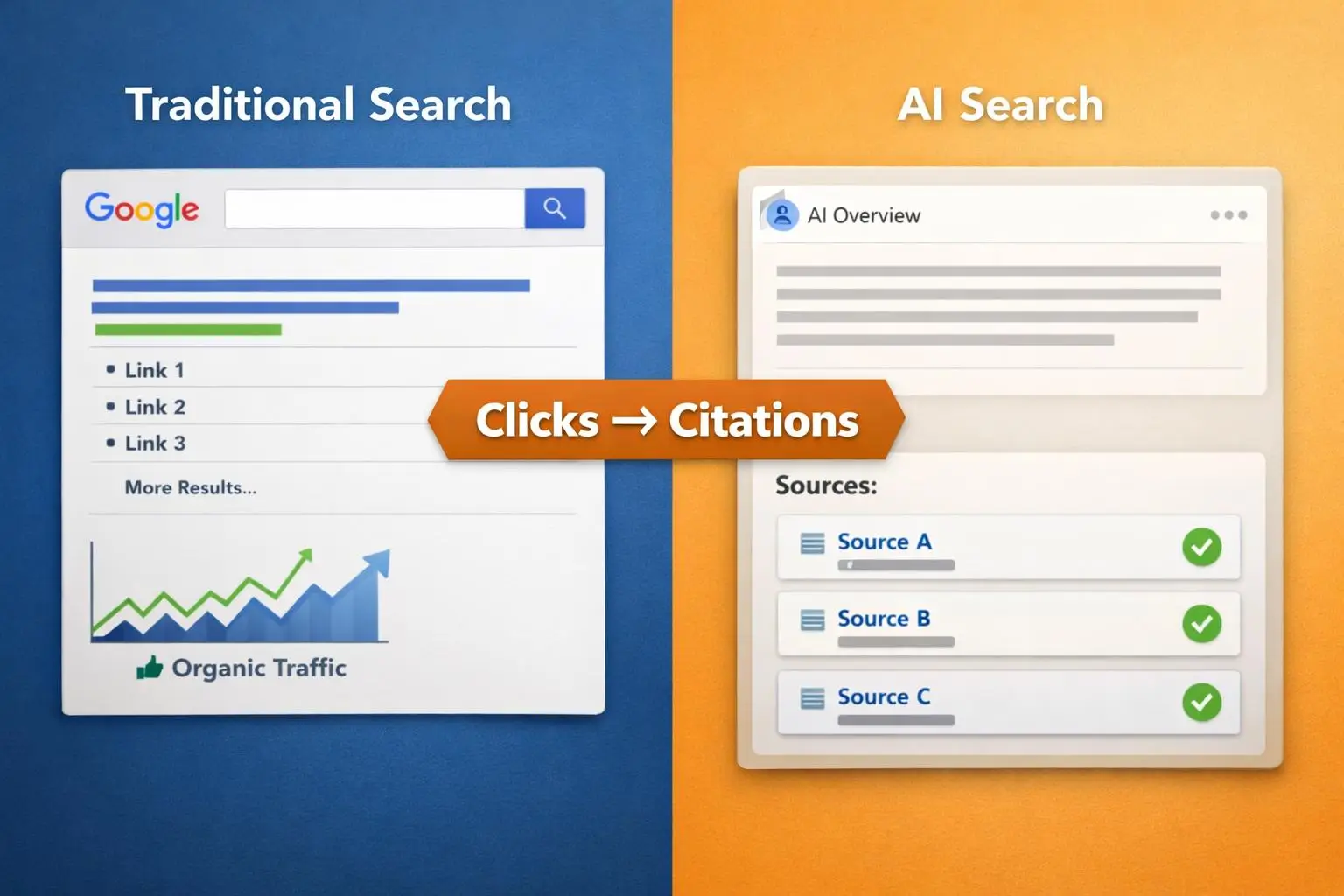
| Traditional Search Ranking | AI Mode Visibility |
| Structured list of ten organic positions per query | Synthesized conversational answer drawing from multiple sources at once |
| Consistent result order for most users searching the same term | The response adjusts organically based on phrasing, follow-up context, and user history |
| Rank tracked with a single static number per keyword | Visibility measured by citation frequency, reflecting multi-source integration |
| Visibility measured by position and click-through rate | Success measured by mention share and source prominence |
Understanding the Mechanics Behind Every AI Mode Response
AI Mode works by taking a user’s query, expanding it into a cluster of related sub-questions, retrieving relevant passages from indexed sources across the web, and synthesizing those passages into a single conversational answer with citations attached. This process, often called “query fan-out,” means a single search can pull from dozens of different pages, each contributing a specific piece of the final response. Grasping what AI overviews mean for SEO and your rankings (What AI Overviews Mean for SEO and Your Rankings) is a useful starting point, because AI mode applies the same underlying retrieval logic at a deeper, more conversational scale.
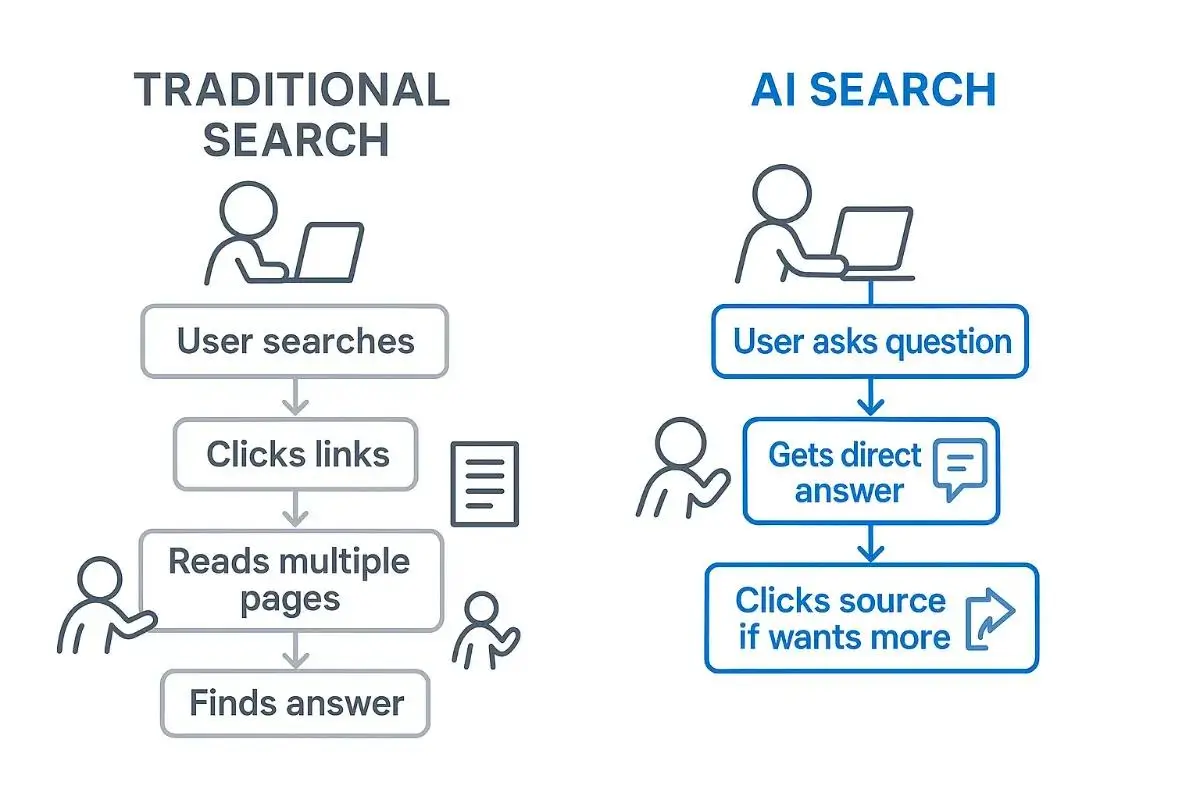
1. Query received
The user’s question is interpreted for intent, context, and any prior conversation history in the session.
2. Query fan-out
The system expands the original question into related sub-queries to cover the full scope of what the user likely wants.
3. Source retrieval
Relevant passages are pulled from indexed pages across the web that best answer each sub-query with credible, specific information.
4. Answer synthesis
The retrieved passages are combined into a single conversational response, with citations linking back to the contributing sources.
Why this changes tracking entirely: Because each response is generated dynamically and adapts fluidly based on phrasing, location, and conversational context, visibility is fluid and multi-dimensional compared to traditional search. A brand can be cited prominently in one phrasing of a question and find opportunities for growth in closely related variations of the same question.
Why Standard Rank Trackers Can Learn from Modern Methodology
Conventional rank tracking software is built around a simple model: submit a keyword, retrieve the search engine results page, and record the position of a given URL. That model assumes a stable, repeatable result for a given query, which is a foundational concept that AI Mode expands upon. Specialized tracking tools have emerged specifically to address this evolution, and understanding how they work is the foundation of accurate AI visibility measurement.
How tracking adapts to the unique nature of AI Mode
- Contextual Variation: Responses are personalized and contextual, meaning the same query can return diverse cited sources depending on the user’s location, search history, and the device or session context it was issued from.
- Narrative Flow: There is a dynamic narrative structure to record, since AI Mode synthesizes a narrative answer rather than ranking ten distinct results in a rigid order.
- Textual Integrations: A brand can be mentioned conversationally within the answer text with or without an accompanying clickable link, which advanced modern crawlers are specifically designed to detect and attribute correctly.
- Conversational Journeys: Follow-up questions within the same session build context continuously, meaning queries are best understood within the flow of how real conversational searches actually unfold.
The Core Metrics That Define AI Mode Visibility Properly
Rather than tracking a single position number, accurate AI mode measurement relies on a small set of metrics that together paint a complete picture of how visible and credible your brand appears across AI-generated conversations. These metrics form the practical foundation of how to rank in Google’s SGE (How to Rank in Google’s SGE: Proven Tactics) and every adjacent AI search surface, because the underlying evaluation logic across these systems shares common ground.
| Metric | What it measures | Why it matters | Tracking priority |
| Citation frequency | How often your domain appears as a cited source across a defined set of representative prompts | The closest equivalent to a traditional ranking signal, reflecting how consistently your content is selected as a trustworthy answer | Essential |
| Source prominence | Whether your citation appears early in the response, mid-text, or as a secondary supporting reference | Earlier and more prominent placement typically correlates with stronger perceived authority on the topic in question | Essential |
| Unlinked brand mentions | Instances where your brand or product name appears within the generated answer text | Reflects brand familiarity and reputation signals that AI models have absorbed, even where no direct source link is shown | Important |
| Competitive citation share | Your citation frequency relative to named competitors across the same set of representative prompts | Gives context to your raw citation numbers and identifies which competitors are currently leading specific topic areas | Important |
| Prompt-level stability | How consistently your citation appears across closely related phrasings of the same underlying question | Identifies whether your visibility is robust and broad-based or specialized and dependent on one exact phrasing | Ongoing |
How Dedicated Tracking Tools Actually Collect This Data
Purpose-built AI Mode tracking platforms work by running a representative set of prompts through live AI Mode sessions on a recurring schedule, capturing the full response text, extracting every cited source URL, and recording where your domain appears relative to competitors. This is fundamentally different from submitting a keyword to a search engine API and parsing a results page, because the tool interacts with a conversational interface and interprets unstructured, generated text rather than structured markup.
- Prompt simulation: Tools maintain a representative bank of prompts covering your priority topics, phrased the way real users actually ask questions, and then run them against AI models at regular intervals to capture how the response evolves over time.
- Citation extraction: Once a response is captured, the tool parses the generated text and any attached source links, identifying every domain and specific URL referenced, then matches those against your site and your competitors’ sites.
- Mention detection: Beyond linked citations, tools scan the conversational answer text itself for brand and product name mentions that appear without an accompanying source link, capturing the fuller picture of brand visibility.
- Trend aggregation: Individual prompt results are aggregated into trend lines and dashboards, showing how citation frequency and competitive position shift week over week as content updates and competitor activity both take effect.
Building a Tracking Setup That Reflects Real Visibility
A useful AI mode tracking program is built around a deliberately constructed prompt set, not a list of exact-match keywords carried over from traditional rank tracking. The quality of your tracking data depends almost entirely on how well your prompt bank reflects the actual range of questions your audience asks, including the natural variation in phrasing that real conversations produce.
Building a prompt set that produces reliable, representative data
- Pull real question phrasing from Search Console queries, customer support transcripts, and sales call notes, since these reflect how people actually ask about your topic rather than how a keyword tool formats it.
- Include several phrasing variants of each core question, since AI Mode responses can shift meaningfully even between closely related ways of asking the same thing.
- Cover the full range of intent stages, from broad awareness questions through to specific comparison and decision-stage prompts, so your tracking reflects performance across the entire customer journey.
- Add a defined list of direct competitors to every relevant prompt set so citation share data is comparative from the outset rather than requiring a separate analysis pass later.
- Refresh the prompt bank periodically as your business, product line, and the language your audience uses all evolve over time, keeping the tracking data representative rather than static.
Turning tracking data into content decisions that move the needle
Collecting citation data is only valuable if it informs what your content team does next. Understanding how to optimize content for Google’s AI-powered search results (How to Optimize Content for Google’s AI-Powered Search Results) means treating tracking output as a direct content roadmap rather than a passive dashboard. A prompt where you seek citation presence is a clear opportunity for content expansion. A prompt where a competitor consistently leads you in citation prominence is an excellent benchmark to study and match.
How to act on citation gaps once you find them
- For prompts with potential for citation presence, check whether a dedicated page addressing that specific question exists on your site, and enhance it with a direct, well-sourced answer near the top.
- For prompts where a competitor is consistently cited ahead of you, review their cited page directly to identify what specific data, structure, or credibility signal is giving it an edge.
- For prompts where you appear as an unlinked mention, strengthen the relevant page’s structured data and author credentials, since this indicates you are already recognized as highly eligible for full citation.
- For prompts with strong, stable citation presence, study what that page is doing well and apply the same structural and sourcing pattern to adjacent, developing content.
Connecting AI Mode Data to Your Wider Search Strategy
AI mode tracking operates in alignment with the wider digital ecosystem. The same underlying principles, sourced citations, structured passages, and credible authorship apply across every generative search surface your audience might use. Teams running Perplexity SEO rank tracking (how to rank on Perplexity) as a beginner’s guide alongside their AI mode program typically find the same successful content opportunities and the same winning patterns showing up across both, which means the optimization work compounds rather than duplicates. The same logic extends further still to platforms outside Google’s ecosystem entirely, which is part of why how to rank on ChatGPT (How to rank on chatgpt) has become an equally important focus for content teams building a complete generative visibility strategy.
The unifying principle: Every generative answer engine, regardless of which company built it, rewards the same underlying qualities: a clear, extractable answer; verifiable sourcing; and consistent topical depth. Tracking AI mode citation data well gives your team a head start on every other generative surface because the content improvements that win citations in one tend to transfer directly to the others.
Reading Your AI Mode Dashboard Without Misinterpreting It
Once a tracking system is in place, the most effective approach is treating short-term fluctuations as natural variations within a dynamic ecosystem. AI Mode responses possess inherent elasticity, and a single week’s shift in citation frequency for one prompt is often a minor calibration rather than a major trend change. Reading the data correctly requires patience and a broad comparative frame.
How to interpret AI Mode tracking data accurately
- Evaluate trends over a rolling multi-week window rather than reacting to any single day or single prompt result, since day-to-day variability is expected and is best understood over time.
- Weight aggregate citation share across your full prompt bank more heavily than performance on any individual high-priority prompt, since the aggregate view is far more stable and representative.
- Cross-reference citation gains against the specific content updates your team made in the preceding weeks to build a clear, evidence-based picture of what is actively driving improvement.
- Pair citation data with branded search volume and direct traffic trends in your analytics platform, since a strong AI Mode presence frequently shows up downstream as growing brand-driven demand.
Accurate Tracking Is the First Step Toward Earning Real AI Visibility
Once your team has a clear, representative view of how often and how prominently you appear across AI Mode conversations, every content decision that follows becomes evidence-based and highly strategic. The brands building this measurement discipline now are positioning themselves to lead in a search environment that rewards genuine clarity, credibility, and depth over simple keyword volume.