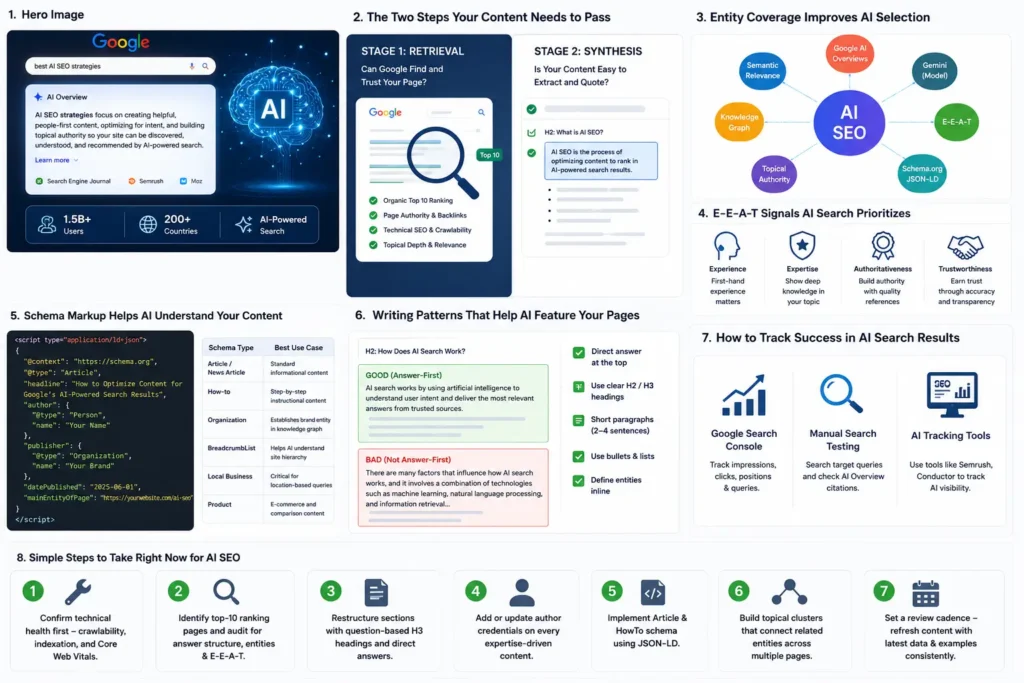
Google’s AI-powered search has crossed a milestone that demands your attention: AI Overviews now reach over 1.5 billion users monthly across 200+ countries. Every time someone searches, Google’s Gemini model reads, evaluates, and synthesizes multiple sources into a single answer block, and only the most trusted, structured, and genuinely useful content makes it into that block.
This is your opportunity. Sites that earn citations inside AI Overviews gain visibility that traditional blue-link rankings simply cannot match. If you want to understand the bigger picture of this landscape, reviewing What AI Overviews Mean for SEO and Your Rankings is an essential starting point. Here is a research-backed, practical path to getting your content chosen. .
The Two Steps Your Content Needs to Pass
Before optimizing anything, understand how Google actually selects content for AI-generated answers. There are two distinct gates your content must pass through.
Stage 1: Retrieval: Can Google Find and Trust Your Page?
Research across thousands of AI Overview citations consistently shows that over 92% of cited pages already rank in the top 10 organic results. This means your conventional SEO foundation, technical health, quality backlinks, and crawlability remain the entry ticket. A page that Google cannot index and trust organically has almost no path into AI overviews.
What builds retrieval-stage trust:
- Page authority and backlink quality from editorially relevant domains
- Core Web Vitals: fast-loading, stable pages signal reliability
- Clean crawl paths: no broken canonicals, redirect chains, or blocked resources
- Topical depth: pages that cover a subject comprehensively within a well-structured site cluster
Stage 2: Synthesis: Is Your Content Easy to Extract and Quote?
Once your page enters Google’s candidate pool, Gemini evaluates how usable your content is for answer assembly. This is where most sites leave opportunity on the table. The model favors passages that are self-contained, clearly structured, and immediately answerable content that doesn’t require the AI to piece together meaning from long, dense paragraphs. This exact balance forms the core framework of AI SEO: How to Rank in Google’s SGE & AI Overviews moving forward.
Synthesis-stage signals that increase your selection probability:
- Direct answers placed at the start of sections, before supporting detail
- Descriptive H2 and H3 headings that mirror how users phrase questions
- Short paragraphs of two to four sentences maximum
- Bullet and numbered lists for multi-step or comparative content
- Inline definitions that clarify entities and concepts without external lookup
How Entity Coverage Helps Your Content Rank in AI Search
Google’s systems increasingly connect content to known entities, people, brands, tools, and concepts to verify credibility and establish topical context. Pages with 15 or more recognized entities per 1,000 words show measurably higher AI overview selection rates compared to content that treats topics as isolated keywords.
How to Build Strong Entity Signals
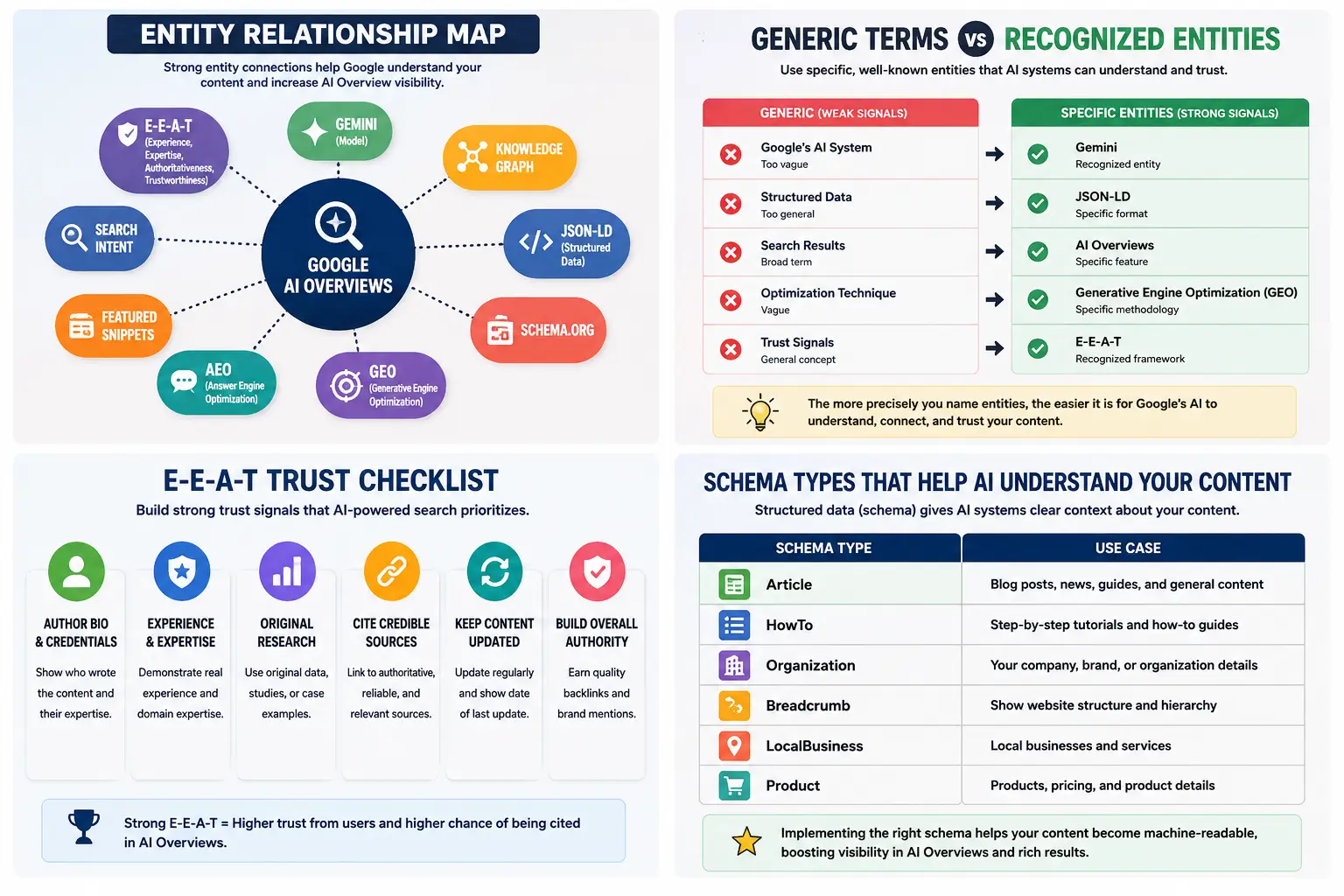
Name the concepts, tools, and frameworks you discuss. Instead of referring to “Google’s AI system,” name it Gemini. Instead of “structured data format,” specify JSON-LD. Precision signals expertise.
Define inline where useful. A sentence like “Schema markup, the structured data language that helps search engines classify your content, should be implemented via JSON-LD” tells Google’s AI exactly what the entity is and how it relates to your topic. This boosts contextual relevance without padding.
Connect entities across your content cluster. If your site covers AI search, Google Search Console, Gemini, E-E-A-T, Knowledge Graph, and generative engine optimization as separate but interlinked topics, Google builds a richer picture of your site’s authority than it would from a single isolated article.
Key entities to weave naturally into AI search content:
- Google AI Overviews, AI Mode, Gemini (model)
- E-E-A-T (Experience, Expertise, Authoritativeness, Trustworthiness)
- Knowledge Graph, structured data, JSON-LD, Schema.org
- Answer Engine Optimization (AEO), Generative Engine Optimization (GEO)
- Featured Snippets, People Also Ask, zero-click search
- Search intent, topical authority, semantic relevance
E-E-A-T Signals That AI-Powered Search Prioritizes
Google’s AI needs reliable sources. Research into AI Overview citation patterns shows that 96% of cited pages carry strong E-E-A-T signals. For content that covers technical, financial, health, or business-critical topics, trust signals move from helpful to essential.
Concrete Trust-Building Actions
Author credentials deserve a dedicated byline. Include the author’s name, professional background, and relevant experience. A short author bio at the top or bottom of the article with a link to a full author profile page gives Google a human entity to verify.
Original data and firsthand experience outperform summaries. If you have conducted research, run tests, or worked directly with the subject matter, surface that explicitly. Phrases that establish experience (“in our testing of 47 AI Overview queries,” “based on analysis of client data from 2024–2025”) carry weight that generic summaries do not. Learn more in our full guide on How to Optimize Content for Google’s AI-Powered Search Results step by step.
Cite credible external sources. Linking to Google’s official Search Central documentation, peer-reviewed studies, or recognized industry reports tells Gemini that your content cross-references verified information rather than standing alone.
Keep content current. Freshness signals matter. A post-date, a “last updated” notice, and genuinely refreshed statistics communicate that your content reflects current conditions, which is particularly important in a search environment that changes quarterly.
How Code Elements Help AI Understand Your Site
The role of schema markup has evolved. As of Google’s March 2026 core update and official I/O 2026 guidance, schema does not directly trigger AI Overview inclusion, but it remains a meaningful trust signal.
The Formats and Types Worth Implementing
JSON-LD is non-negotiable. All major AI systems, including Gemini, prefer JSON-LD because it is cleanly separated from page HTML and easier to parse programmatically. Implement it in the document head.
Schema types with the strongest current impact:
| Schema Type | Best Use Case |
| Article / News Article | Standard informational content |
| How-to | Step-by-step instructional pieces |
| Organization | Establishes brand entity in the knowledge graph |
| BreadcrumbList | Helps AI understand site hierarchy |
| Local Business | Critical for location-based queries |
| Product | E-commerce and comparison content |
FAQ schema sunset note: As of May 2026, FAQ rich results no longer display in Google Search. Existing FAQPage markup is harmless but produces no SERP lift. Redirect that implementation effort toward HowTo and Article schemas where applicable.
Validation matters more than volume. Your schema must precisely match the visible content on the page. AI systems check for consistency between markup and rendered content; mismatches reduce credibility rather than building it.
Writing Patterns That Help AI Feature Your Pages
The way you organize information at the paragraph and section level directly affects whether Gemini can extract a clean, quotable passage. These structural patterns consistently produce citeable content.
The Answer-First Architecture
Open every major section with the direct answer or key takeaway. Follow it with supporting evidence, examples, and nuance. This mirrors how AI systems assemble answers: they pull the clearest response first and supplement it with context.
Instead of this:
“There are several factors involved in how Google decides which content to include in its AI Overviews, and researchers have studied this extensively over the past year…”
Write this:
“Google selects AI Overview content based on retrieval authority, passage extractability, and E-E-A-T signals — with organic top-10 ranking as the primary filter.”
Section Design That Supports Extraction
Each H2 or H3 section benefits from:
- A direct, question-informed heading, i.e., “How Does Google Select AI Overview Sources?” rather than “Selection Process”
- A 1–2 sentence summary at the opening that can stand alone as a citation
- Supporting detail in short, discrete paragraphs that each address one idea
- Bullet lists for multi-part answers as they are scannable for users and highly extractable for AI
Conversational Keyword Integration
AI search processes meaning and intent, not keyword frequency. Long-tail, question-based phrasing triggers AI overviews far more reliably than broad head terms. Build sections around real questions your audience asks: “What makes content eligible for AI overviews?” and “How do I know if my content appeared in an AI summary?” “Does structured data improve AI citation rates?” and answer them directly within your content. This structural evolution helps explain why zero-click searches are happening and how to win anyway by creating unique informational value.
How to Track Your Success in AI Search Results
Earning citations in AI Overviews is a measurable outcome, and consistent tracking reveals what is working and where gaps exist.
Google Search Console remains the baseline. Track impressions, clicks, and position data segmented by query type. AI mode traffic increasingly shows up under informational query categories.
Manual search testing is still valuable. Run your target queries in Google and observe which sources appear in AI Overviews. Compare your content structure, entity coverage, and answer directness against cited competitors to identify specific gaps.
Third-party AI tracking tools (Conductor, Semrush AI Search Optimizer, and similar platforms) provide cross-platform visibility across Google, ChatGPT, and Perplexity simultaneously, useful for brands that need to understand where their content surfaces in AI-generated answers beyond Google alone.
The pattern that emerges from monitoring is consistent: pages that earn AI citations combine strong organic authority with high passage extractability, clear entity relationships, and demonstrable expertise signals. No single tactic achieves this; it is the result of content built with both human readers and AI synthesis in mind from the first sentence.
Simple Steps to Take Right Now for AI SEO
If you are starting from scratch or auditing an existing content library, focus on these actions in order:
- Confirm technical health first — crawlability, indexation, and Core Web Vitals, before any content changes
- Identify your top-10-ranking pages and audit them for answer-first structure, entity coverage, and E-E-A-T signals
- Restructure sections using H3 headings that reflect real user questions, and open each section with a direct, extractable answer
- Add or update author credentials on every piece of expertise-driven content
- Implement Article and HowTo schema via JSON-LD on your highest-traffic informational pages
- Build topical clusters that connect related entities across multiple pages, reinforcing your site’s authority on the subject domain
- Set a review cadence — AI search signals evolve quickly; content refreshed with current data and updated examples consistently outperforms content left static
AI-powered search rewards the same qualities that make content genuinely useful to people: clarity, accuracy, expertise, and structure. Sites that invest in these qualities earn citations not through tricks, but because their content is exactly what Google’s AI system wants to surface for its users.