Google’s Search Generative Experience has matured from a test feature into the primary way hundreds of millions of users discover information. The rules for earning visibility inside it are specific, learnable, and already producing measurable results for teams that have applied them. This guide covers every tactic that works, the data behind each one, and exactly how to implement them across your content program.
How Google’s SGE Selects Sources and Why That Changes Everything
Traditional SEO rewarded the page that best matched a keyword. Google’s SGE rewards the source that best answers the intent behind a query, across its full context, with verifiable credibility. That distinction changes what you optimize for, how you structure content, and how you measure success. Understanding what AI Overviews mean for SEO and your rankings is the essential starting point because the selection mechanism is fundamentally different from a ranking algorithm.
SGE uses Google’s Gemini AI to analyze query intent, pull relevant information from multiple crawled sources, synthesize a coherent answer, and select citations that substantiate the summary. Pages with clear authority signals, well-structured answers, and strong semantic relevance are pulled in. Pages without them are invisible, regardless of their traditional ranking position. Research from Ahrefs confirms that only 12% of AI Overview citations link to the number one ranked page, which means rank alone is no longer sufficient for visibility.
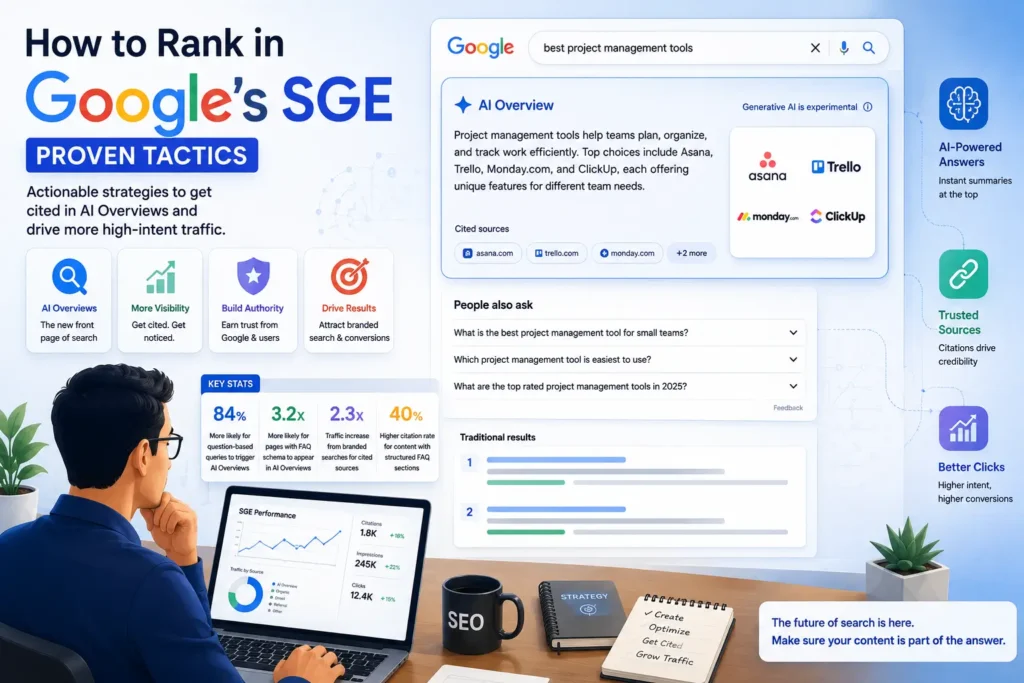
- 84% — More likely for question-based queries to trigger an AI Overview
- 3.2x — More likely for pages with FAQPage schema to appear in AI Overviews
- 2.3x — Traffic increase from branded searches for AI Overview-cited sources
- 40% — Higher citation rate for content with properly structured FAQ sections
The core shift in SGE: Success is no longer measured by ranking position alone. It is measured by citation frequency inside AI Overviews, which delivers branded search lifts, higher-intent traffic, and compounding authority gains that traditional blue-link rankings cannot replicate. Sites cited in AI overviews see a 2.3x increase in branded searches over time, reflecting the authority signal that AI citation generates.
Proven Tactics to Rank in Google’s SGE and AI Overviews
These tactics are drawn from research across Semrush, Ahrefs, BrightEdge, Search Engine Land, and Frase and reflect patterns consistent across cited sources in 2024 and 2025. Applying them in combination produces measurably stronger results than applying any single tactic in isolation. This is the core of AI SEO and how to rank in Google’s SGE and AI Overviews in practical terms.
- Open every page with an atomic answer in the first 50 to 70 words
SGE scans for extractable, direct answers within the opening content of a page. If your primary query answer does not appear clearly within the first 200 words, your page becomes a poor citation candidate regardless of the depth that follows. Structure every important page to deliver the core answer immediately, then build the supporting detail around it. - Build topical authority through content clusters, not isolated pages
SGE evaluates domain-level expertise by mapping how thoroughly a site covers a topic and its related subtopics. A single well-written page does not demonstrate expertise. A pillar page linked to a full cluster of supporting content on adjacent subtopics signals topical depth that AI systems reward with preferred citation status. Google recognizes topic cluster architecture as a go-to resource signal.
Implement the schema types that unlock AI Overview citation eligibility
A controlled search engine land experiment in 2025 found that a page with a well-implemented JSON-LD schema appeared in a Google AI Overview and reached position three organically, while an identical page with no schema failed to be indexed at all. Schema markup does not directly affect rankings, but it opens the eligibility gates for AI Overviews citations, Knowledge Graph entity recognition, and rich result qualification. - Optimise for entities and Knowledge Graph recognition, not just keywords
SGE uses Google’s Knowledge Graph to understand people, organizations, places, concepts, and the relationships between them. Pages optimized for entity recognition use consistent naming that matches Knowledge Graph entries, link to authoritative sources about those entities, and implement entity-specific schema. This semantic approach helps AI models understand your content’s meaning rather than just its vocabulary. - Target question-based and long-tail queries that consistently trigger AI Overviews
Queries phrased as questions are 84% more likely to display an AI overview than keyword-style queries, according to 2025 research. Long-tail conversational queries with natural sentence structure are the highest-opportunity entry points for AI citation, particularly for sites building authority in a competitive vertical. Structuring your keyword research around questions your audience is actually asking, rather than broad head terms alone, produces significantly stronger SGE results. - Strengthen E-E-A-T at the page, author, and domain levels simultaneously
Experience, expertise, authoritativeness, and trustworthiness signals are the most consequential trust framework for SGE citation eligibility. AI systems evaluate the credibility of sources before deciding what to include in an overview. Author credentials, primary source citations, organizational trust signals, and domain-level editorial standards all contribute to the composite trust score that determines whether your content gets selected. - Create original data and proprietary insights that provide information gain
AI systems can synthesise what is already widely published. They cannot cite data that exists only on your site. Original surveys, benchmark reports, firsthand case studies, and proprietary platform analytics create genuine information gain, which is one of the strongest citation signals available. This is the foundation of what professionals call GEO (Generative Engine Optimization), and it separates sites that get cited from sites that get synthesized away.
The Schema Types That Open SGE Eligibility Across Your Content
Understanding how to optimize content for Google’s AI-powered search results requires knowing which schema types carry the most weight for SGE specifically. Not all markup is equal, and adding irrelevant schema to every page produces no benefit. The following six types have the strongest documented impact on AI Overview citation eligibility and knowledge graph integration.
Organization
- Purpose: Establishes entity identity for your brand across Google’s Knowledge Graph and all AI retrieval systems that reference it
- Apply to: homepage and About page
Article/Blog Posting
- Purpose: Signals content type, author credentials, publication date, and update freshness. Author markup is particularly important for E-E-A-T scoring
- Apply to: Every article and guide
FAQ Page
- Purpose: Pages with FAQPage markup are 3.2x more likely to appear in AI overviews. Use it where FAQs genuinely serve the reader, not as a formatting trick
- Apply to: informational and service pages
How-to
- Purpose: Signals structured step-by-step content that AI systems extract directly when building procedural answer summaries for process queries
- Apply to the following: Tutorial and guide content
Person
- Purpose: Builds entity profiles for authors and experts, anchoring their credentials in Knowledge Graph and improving author-level E-E-A-T scoring across their content
- Apply to: author and team pages
Product
- Purpose: Required for transactional and commercial pages to qualify for merchant features and AI Overview citation within product and service queries
- Apply to: product and service pages
How Content Structure Determines Whether AI Systems Can Extract Your Answer
The way a page is physically organized determines how easily AI retrieval systems can extract a citable answer from it. Pages structured for human reading alone often contain valuable information that AI models cannot locate efficiently, which excludes them from citation consideration regardless of content quality.
The content format patterns that SGE citation data consistently supports
- Question-based H2 and H3 headings that mirror the natural language of actual search queries, rather than keyword-stuffed or vague labels
- A TL;DR or summary box in the opening section delivering the core answer in 50 to 70 words, positioned before any contextual background
- Bullet and numbered list formatting for multi-step processes, comparisons, and feature breakdowns, which AI systems extract significantly more reliably than embedded prose
- Semantic HTML5 elements, including article, section, and aside tags used meaningfully rather than generic div containers throughout the page structure
- Table markup with proper thead, tbody, and scope attributes for any comparative or data-heavy content, because tabular structure is highly extractable by AI retrieval systems
- Internal linking architecture that connects each page within its topic cluster, reinforcing semantic relevance signals across the full content group
Tracking Your SGE Performance: The Metrics That Reflect AI Search Visibility
Standard rank tracking does not capture SGE performance. AI mode website rank tracking and how it works require a different measurement framework because a page can hold a top ranking and still lose traffic when an AI overview answers the query without a citation. The following measurement approach gives you a complete and accurate view.
| Metric | What to track | Recommended tool | Priority |
| AI Overview citation rate | How often your pages are cited as sources within AI-generated summaries across your target keywords | BrightEdge, Semrush AI Toolkit | Essential |
| Impressions vs click ratio by intent | CTR segmented by informational, commercial, and transactional query types to identify which segments are gaining or losing ground | Google Search Console | Essential |
| Branded search volume trend | Month-over-month growth in direct branded searches, which reflects the cumulative authority effect of AI Overview citation | Google Search Console, Ahrefs | Essential |
| SGE keyword trigger monitoring | Which of your ranking keywords now trigger AI Overviews and how that changes week to week as Google expands coverage | Semrush, Advanced Web Ranking | Important |
| Schema validation coverage | Percentage of priority pages with valid, error-free structured data confirmed in Google Search Console’s enhancements report | Google Rich Results Test, Search Console | Important |
| Topic cluster authority signals | Backlink growth, internal link depth, and topical coverage breadth across each content cluster to assess cluster authority maturity | Ahrefs, Semrush Site Audit | Ongoing |
Recommended SGE Toolset
- AlsoAsked and AnswerThePublic
Surface the exact question-format queries that trigger AI Overviews within your topic area, giving you a direct list of high-opportunity content gaps - Semrush AI Overviews Toolkit
Track citation rates, monitor keyword-level AI Overview presence, and identify which competitor pages are being cited in your target query set - Google Rich Results Test
Validate structured data implementation for every schema type, confirm eligibility for rich results, and identify markup errors before they affect citation eligibility - BrightEdge SGE Tracker
Monitor AI Overview performance metrics, track changes in AI search result formats across your keyword portfolio, and benchmark performance against industry competitors
How to Adapt Your Content Strategy to Win in a Zero-Click Environment
The emergence of zero-click searches changes the relationship between search visibility and website traffic in ways that demand a strategic rethink. Understanding why zero-click searches are happening and how to win anyway reveals that winning in this environment means redefining what a win looks like. A page cited in an AI overview without generating a click still builds brand familiarity, domain authority, and the kind of trust that converts into direct searches later.
- Answer the “what” in the opening summary section at a level that satisfies AI extraction, then reserve the “how,” the “why,” and the specific implementation detail for the full page, which gives readers a reason to click through for the complete picture
- Build FAQ sections that answer the surface-level questions AI Overviews are likely to serve, while the page itself goes deeper into the nuance, context, and expert perspective that a summary cannot contain
- Include original data, case study outcomes, and proprietary benchmarks that are referenced in your summary but fully accessible only by visiting the page, creating genuine click-through incentive
- Invest in building branded search volume as a parallel channel, because a user who sees your brand cited in an AI Overview and searches for your brand directly is a high-intent visit that bypasses the click-through issue entirely
Building a Durable Foundation with Credible Content
The teams earning consistent AI overview citations share one quality. They built content programs that prioritize genuine depth, clear structure, and verifiable authority at every level. That foundation does not change with each algorithm update. It compounds. Start with your highest-value pages, apply the schema types that unlock eligibility, and build the original data assets that give AI systems something worth citing and readers something worth clicking through for.