If your organic traffic has been shifting recently, you are not imagining it. Google’s search experience has changed at its core, and the businesses that understand what is driving that change are already pulling ahead. Google’s Search Generative Experience and AI Overviews now reach over 1.5 billion monthly users, sitting at the very top of results before any traditional link appears. This guide covers everything you need to build strong, lasting visibility in that new environment, from earning AI citations to optimizing for voice search, tracking multi-platform rankings, and winning meaningful traffic even as zero-click behavior grows.
What AI Overviews Are Actually Doing to Your Organic Rankings
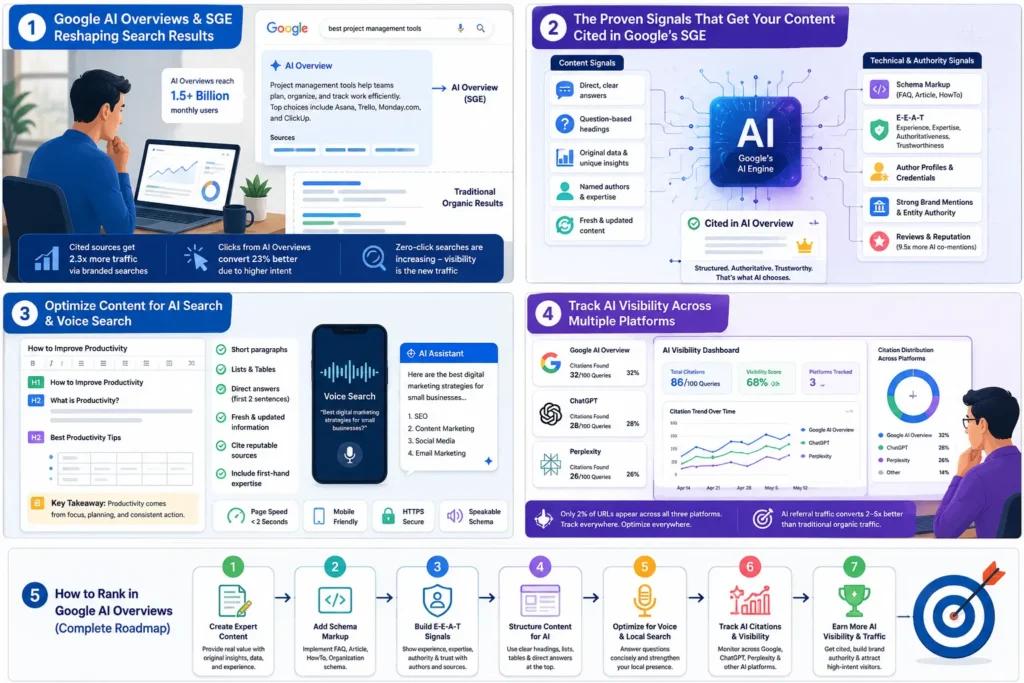
Most websites that have seen traffic shifts are experiencing something specific: their pages still rank, but far fewer people click. The reason is straightforward. AI Overviews now occupy prime real estate at the top of search results, pushing traditional organic listings down significantly and creating a new hierarchy where being cited in the AI Overview becomes more valuable than holding the first traditional result.
This is a structural change, and it brings genuine opportunity for the brands that respond to it correctly. Cited sources in AI Overviews are seeing a 2.3x increase in traffic through branded searches because being named as a trusted source builds the kind of brand recognition that converts into direct searches, repeat visits, and stronger long-term authority. The visitors who arrive through an AI citation are already informed about your brand and considerably more likely to take meaningful action.
The clicks that do come through when an AI overview is present convert 23% better, because those users have already read a summary and are seeking deeper information, making them genuinely high-intent visitors. Understanding this is the shift that separates brands building durable search strategies from those chasing numbers that no longer reflect how search actually works. Understanding what AI Overviews mean for your rankings and category (What AI Overviews Mean for SEO and Your Rankings) is the foundation that every other tactic in this guide builds on, because the patterns differ significantly by industry, query type, and user intent stage.
The Proven Signals That Get Your Content Cited in Google’s SGE
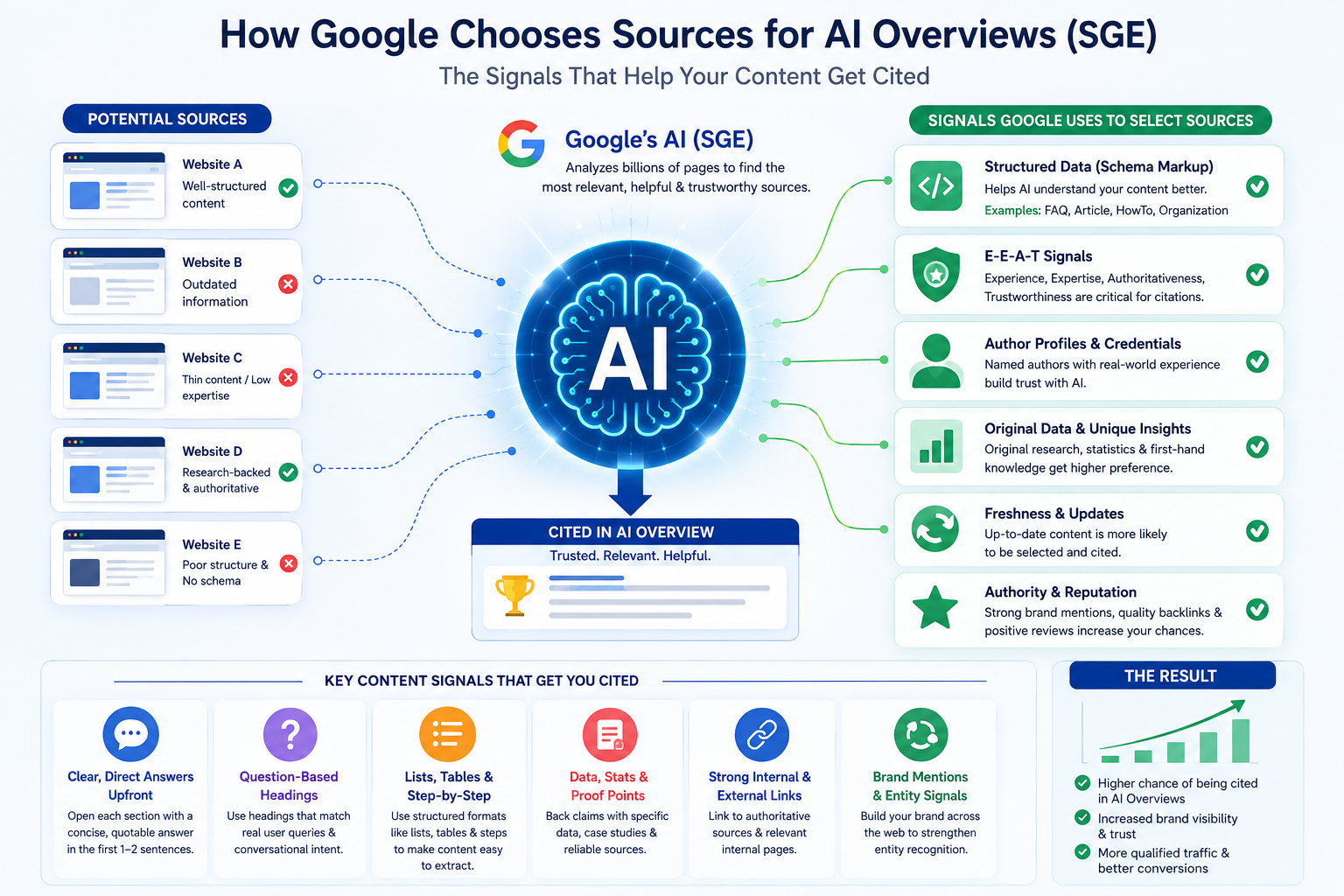
Google’s AI does not select sources randomly. It evaluates a specific, learnable set of signals to determine which pages are structured, authoritative, and trustworthy enough to surface in front of over a billion users. Google’s AI has a clear preference for content that is clearly structured through headings, lists, and tables and factually dense through specific data points and direct answers rather than broad, vague writing.
The most important principle is this: every section of a well-optimized page opens with a direct, factual answer before expanding into supporting evidence and context. AI extraction systems pull the cleanest, most directly answerable segment available on a page. If that segment is buried under paragraphs of framing, it will not be extracted, and your page will not be cited, even if the content is genuinely excellent.
Building the Technical Foundation That Makes Citation Possible
Pages implementing comprehensive structured data are roughly one-third more likely to be cited or surfaced in AI-generated answers, making schema markup one of the most impactful technical investments available in AI SEO. FAQ schema, Article schema, HowTo schema, and Organization schema each contribute meaningfully to this signal stack and are well within the capability of any experienced development team or SEO professional.
E-E-A-T, encompassing experience, expertise, authoritativeness, and trustworthiness, is the foundation of SGE visibility and requires demonstrable credentials and firsthand knowledge to earn consistent citations. Named authors with verifiable professional backgrounds, original research drawn from real work, primary data, and transparent sourcing all strengthen the E-E-A-T profile that determines whether your domain qualifies as a citation-eligible source.
Here are the content signals that most consistently correlate with AI Overview inclusion:
- Sections that open with a clear, quotable answer within the first two sentences rather than building gradually toward the main point
- Headings written as questions or direct topic declarations that match the conversational phrasing of real user queries
- Original data, proprietary insights, and statistics that cannot be assembled from secondary sources, because unique knowledge is precisely what AI systems prioritize surfacing
- Named authors with linked credentials or professional profiles that establish genuine human expertise behind the content
- Regular content updates that reflect the most current developments in a topic, particularly where outdated information carries credibility or accuracy risk
AI models understand content through entities, which are the people, places, and concepts along with their relationships, rather than through keyword density. Building entity authority through consistent brand mentions across authoritative third-party domains, structured data using Person and Organization schema, and a content architecture that establishes clear topical ownership produces advantages that compound over time and are genuinely difficult for competitors to replicate quickly.
The proven tactics for ranking in Google’s SGE and earning consistent AI citations (How to Rank in Google’s SGE: Proven Tactics) are structural investments rather than quick fixes, and that is precisely what makes them worth building now while many competitors are still operating on older optimization frameworks.
How to Optimize Content Specifically for AI-Powered Search Results
Content optimization for AI search differs from traditional on-page SEO in ways that are specific, measurable, and actionable. The most important shift is from keyword alignment to intent alignment. Google’s AI evaluates whether a page genuinely satisfies the complete need behind a query, not whether a target phrase appears a certain number of times.
AI search systems are less concerned with word-for-word keyword relevance and more focused on whether a page answers the intent behind the query. This means mapping every piece of content to the specific need, question, or decision a user in that search context actually has, and covering the full scope of that need with depth, structure, and first-hand expertise.
The Formatting and Freshness Standards AI Systems Reward
Short paragraphs, comparison tables where relevant, numbered process steps, and clean heading hierarchies give AI extraction systems clearly attributable content segments to work with. Dense, unbroken prose with no structural signposting is harder to cite and far easier for AI to synthesize without attribution, which is the outcome every content creator wants to avoid.
Freshness is weighted more heavily in AI search than it was in traditional ranking systems. Refreshing content frequently sits alongside writing concise answers, using structured formatting, citing reputable sources, and including firsthand expertise as the core content optimization requirements for AI overview eligibility. Establishing a regular audit cycle to update statistics, expand sections based on emerging questions, and reflect new developments keeps content competitive in AI source selection over time.
Review signals have also emerged as a significant AI citation driver. Brands with fully optimized review profiles received 9.5 times more co-mentions from AI systems than brands with minimal review presence, meaning AI platforms recommend these brands even when consumers are asking about competitors. Building a strong review presence across Google Business Profile and major third-party platforms are now a direct AI SEO tactic and one that most businesses can act on immediately.
Zero-Click Searches, AI Mode Tracking, and Winning Without Every Click
Nearly two thirds of all Google searches end without the user clicking on any result, with the remaining clicks increasingly concentrated on navigational and transactional queries where user intent demands a destination. This is not a temporary fluctuation. It is the direction search has been moving for years, and AI overviews have accelerated it significantly.
The good news is that zero-click visibility is still valuable visibility. Your brand may be mentioned in AI responses without generating a single click, highlighted in knowledge panels without direct attribution, or recommended through voice search on smart devices, and none of these appearances show up in traditional click-through metrics. Businesses that measure only session data are missing a meaningful portion of the brand impact their content is generating.
The most resilient content strategy in a zero-click environment combines citation-earning informational content with proprietary resources that AI cannot fully synthesize. Interactive tools, original research, industry benchmarks, calculators, and community-driven content retain clicks because they deliver utility that a summarized answer cannot replicate. AI referral traffic drove 12.1% of signups for Ahrefs despite representing only 0.5% of total visitors, which illustrates the business case precisely: citation-driven traffic converts at rates that make volume comparisons with traditional organic traffic almost beside the point.
Building Strong Multiplatform Insights with AI Mode and Perplexity Rank Monitoring
AI mode and perplexity rank tracking require a different methodology than traditional keyword position monitoring. These platforms generate synthesized answers that may or may not cite your domain, and the metric that matters is citation frequency across your defined query set over time. Effective tracking starts with a representative set of queries aligned with your topic clusters, run regularly through generative search monitoring tools, with citation presence recorded systematically across each platform.
Only 2% of cited URLs appear across AI Overviews, ChatGPT, and Perplexity simultaneously, while 91% of citations appear in only one AI engine. This finding makes multi-platform tracking a strategic necessity rather than an optional extra. Visibility in Google AI Overviews does not automatically mean visibility in Perplexity or ChatGPT, and each platform has distinct source selection patterns worth understanding and optimizing for separately.
Understanding how Perplexity rank tracking works and why that data matters for your broader AI visibility strategy (Perplexity SEO Rank Tracking: A Beginner’s Guide) gives you a meaningful competitive edge, particularly for local SEO, where Perplexity’s real-time web crawling and ChatGPT’s training-data-based recommendations behave very differently and reward different optimization priorities.
Voice Search, Local SEO, and the Shift in How Users Find Businesses
Voice search and AI-powered search have converged around the same user behavior: conversational, intent-specific queries that expect a single, accurate, immediate answer. Optimizing for voice today delivers simultaneous benefits for AI overview eligibility, local visibility, and mobile performance, making it one of the highest-leverage investments available in a unified AI SEO strategy.
The most important voice search ranking factors are concise answer construction under 30 words for the core response, question-based heading structure that mirrors how people speak their queries, page speed under two seconds on mobile, HTTPS security, and strong local signals for geographically anchored searches. SpeakableSpecification schema explicitly signals to Google which content segments suit text-to-speech delivery, and implementing it is a practical step that pays dividends across both voice and AI search simultaneously.
What Voice Search Has Done to Local Discovery for Small Businesses
For local businesses, voice search has transformed how customers find and evaluate nearby options. When someone asks their smart speaker or mobile assistant for a recommendation near them, the result is drawn from a combination of Google Business Profile data, review signals, local content, and Knowledge Graph information. The business that wins that recommendation earned it through consistent, complete listings, a strong review profile, and locally relevant published content.
Smart speakers deliver a single spoken answer, and the interaction ends. There is no ranked list, no second option, and no further browsing. Winning that response is consequently as much a brand-building outcome as a traffic-driving one, because users who hear a recommendation from a trusted voice assistant remember it and search for that brand directly afterward, feeding the branded search signal that strengthens AI citation eligibility across every platform simultaneously.
How User Intent Has Shifted and What Your Content Strategy Needs to Reflect
The most consequential change that voice and AI search together have introduced is the expectation that the search interface itself will complete the task. Users expect a direct answer, a local recommendation, a process walkthrough, or a clear comparison delivered immediately. AI systems evaluate whether a page answers the intent behind the query rather than whether it matches a keyword pattern, and voice search operates on exactly the same principle.
Optimizing for mobile-first and voice search simultaneously (How to Optimize for Mobile-First & Voice Search Simultaneously) is entirely achievable because both channels reward identical technical foundations: fast pages, clean mobile layouts, structured data, locally relevant content, and direct answers placed near the top of the page. Building for both at once is the most efficient path to comprehensive AI-era search visibility, and it is the approach that positions a website to earn citations, voice recommendations, and high-intent organic clicks across every search surface where your audience is active.