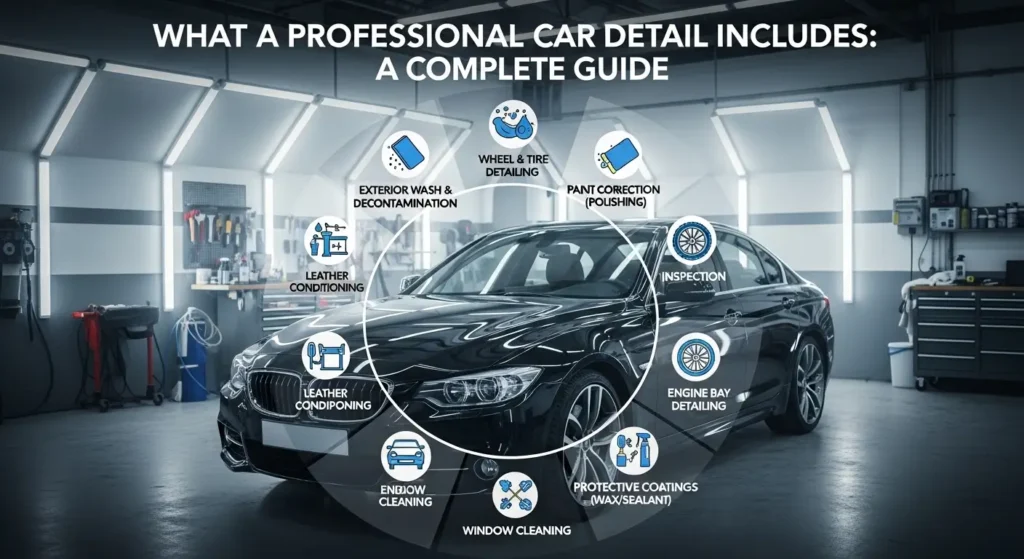
Most people think a clean car starts and ends with a trip through the automatic wash and a quick vacuum of the floor mats. But if you have ever looked at your paint under direct sunlight and seen those spiderweb-like swirls, or noticed that your cup holders still feel sticky after a “cleaning,” you know that a standard wash isn’t enough.
That is where professional car detailing comes in. Detailing is not just a fancy term for a car wash; it is a systematic process of cleaning, restoring, and protecting every inch of a vehicle. It is the difference between a car that looks “okay” and a car that looks like it just rolled off the showroom floor.
In this guide, we will break down exactly what a professional car detail includes, why the process matters, and some of the deep-cleaning steps that most people overlook.
Exterior Detailing: The Outside Glow-Up
The exterior of your car faces a constant battle against road salt, bird droppings, UV rays, and brake dust. A professional detailer doesn’t just spray these away; they treat the paint like a delicate surface.
1. The Pre-Wash and the Two-Bucket Method
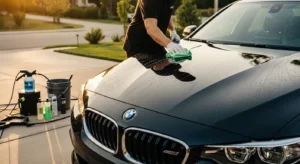
Before a sponge ever touches the car, a detailer performs a pre-wash. This often involves a “snow foam” treatment that clings to the dirt and pulls it down toward the ground.
When it comes to the physical wash, professionals use the two-bucket method. One bucket is filled with pH-balanced car soap, and the other is filled with plain water to rinse the wash mitt. This ensures that you aren’t rubbing the dirt you just took off the bumper back onto the hood, which is the number one cause of swirl marks.
2. Decontamination
Even after a wash, your paint might feel “rough” if you run your hand over it. This is caused by embedded contaminants like iron particles from your brakes and industrial fallout.
- Iron Removers: A special chemical is sprayed on that turns purple as it dissolves metal particles.
- The Clay Bar: Detailers use a synthetic clay bar to glide over the paint. This bar “grabs” any microscopic grit left behind, leaving the surface as smooth as glass.
3. Machine Polishing and Paint Correction
This is where the magic happens. If your vehicle has light scratches or a dull, oxidized finish, Car polishing is used to restore gloss and improve the paint finish.
- Enhancement Polish: A light application to restore the luster.
- Paint Correction: A more involved application where a microscopic layer of clear coat is removed to fix scratches. This is a technical application that requires a skilled hand and a lot of knowledge about paint.
4. Long-Term Protection
After the paint is perfected, it needs to be protected. This can be done through the following applications, depending on the package you choose:
- Wax: Gives the vehicle a nice, deep glow but only lasts 1-2 months.
- Sealants: Synthetic sealants can last 6 months.
- Ceramic Coatings: A liquid polymer that bonds to the paint and lasts for years, making the vehicle extremely easy to clean.
5. The “Hidden” Exterior Details
A full detail includes the areas people often forget:
- Engine Bay: Cleaning the grease and grime from the engine and dressing the plastic covers so they look new.
- Wheelbarrows: Cleaning not just the face of the wheel but also the deep inside part behind the spokes.
- Door Jambs: Wiping down the metal frames inside the doors where grease and dirt tend to hide.
Interior Detailing: The Inside Refresh
You spend 100% of your driving time inside the car, so this is arguably the most important part of car cleaning and detailing. It’s about more than just a vacuum; it’s about sanitization.
1. Precision Vacuuming and Compressed Air
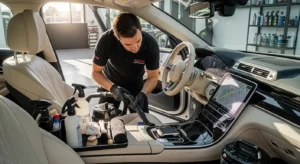
Detailers do not just vacuum the floor mats. They also use compressed air to blow out dust that has collected in the tight spaces of the dashboard, the interior of the air vents, and between the seats. It is only after the dust has been “blown out” that the heavy-duty vacuuming of every crevice begins.
2. Steam Cleaning
One of the most useful tools that any detailer has at his or her disposal is the vapor steamer. High-heat steam can kill bacteria and dust mites that have collected in the upholstery of your car without soaking the fabric in water. It is ideal for cup holders, door pockets, and even the headliner (the ceiling of your car) without causing the glue to run.
3. Carpet and Fabric Extraction
For cars with stains or “that smell,” a detailer uses an extractor. This machine pumps hot water and cleaner into the fabric and immediately sucks it back out. You would be shocked at how black the water looks, even in a car that appears relatively clean.
4. Leather Care
Leather isn’t just “wiped down.” It is cleaned with a dedicated leather brush to get dirt out of the “pores” of the material. Afterward, a conditioner is applied. This keeps the leather supple and prevents it from cracking under the hot sun.
5. Glass and Final Touches
The interior glass is cleaned with a lint-free towel to ensure there is no “haze”—that oily film that builds up on the inside of the windshield. Finally, all plastic and vinyl surfaces are treated with a non-greasy UV protectant.
How Detailing Changes Based on Your Needs?
Not every car needs the “full works” every time. The process is often tailored to the specific vehicle.
- Maintenance Detail: A 2-hour “refresh” for a car that is already in good shape. It focuses on a thorough wash and a light interior vacuum.
- Restoration Detail: This can take 6–10 hours. It involves heavy stain removal, pet hair extraction, and multi-stage paint correction.
- The “New Car” Detail: Even new cars often have “rail dust” from shipping. Many owners take new cars straight to a detailer for a ceramic coating to lock in that factory shine immediately.
What You Are Really Paying For?
When you pay for a professional detail, you aren’t just paying for soap and water. You are paying for:
- Specialized Chemicals: Pros use cleaners that are safe for specific surfaces (like Alcantara, carbon fiber, or matte paint) that household cleaners would ruin.
- Expertise: Knowing exactly how much pressure to apply with a polisher so you don’t burn through the paint.
- The Tools: Industrial steamers, extractors, and dual-action polishers that the average car owner doesn’t have in their garage.
Conclusion
At the end of the day, it is an investment. A car that is regularly detailed will always have a higher resale value than a car that is not. And aside from all of this, there is a certain “peace of mind” that comes from sitting in a cabin that is truly clean and sanitized.
A good detail is always designed for your goals. Are you looking to get top dollar for a sale, or do you simply want your daily driver to feel like a luxury vehicle again? Understanding what goes into the process is going to help you make the best decision for your vehicle.